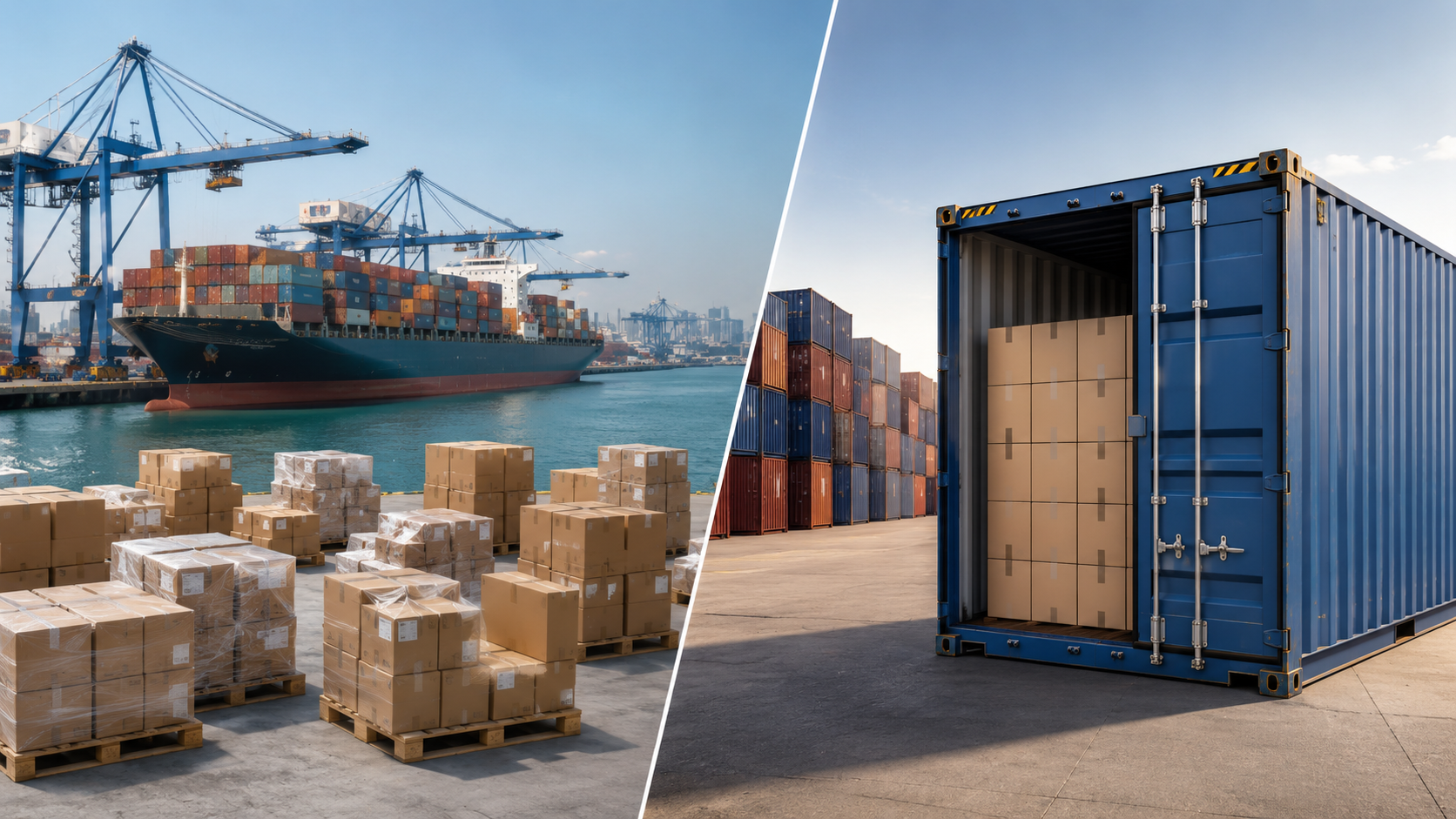
Should you decide between LCL and FCL by CBM alone?
As import volume gradually increases, many teams eventually ask the same question: would it be better to book a whole container?
That question often appears when an LCL quote feels higher than expected or when the cargo volume starts moving beyond about 10 CBM. But there is no single CBM number where FCL automatically becomes cheaper.
The break-even point changes by origin, destination, container type, ocean freight, CFS charges, local costs, cargo weight, and cargo volume. In practice, it is more accurate to compare the total cost to destination than to decide from CBM alone.
Start with the difference between LCL and FCL
LCL, or Less than Container Load, means several shippers share one container. It is commonly used when one shipper does not have enough cargo to fill a container.
FCL, or Full Container Load, usually means one shipper uses one container under a container-level booking. FCL does not mean the container must be filled completely. Even if space remains inside, the shipment can still move as a full-container booking.
That is why some shipments switch from LCL to FCL before the container is physically full.
Why LCL works well for small shipments
The main advantage of LCL is that the shipper pays for the space or chargeable weight needed, not for an entire container. For example, a 3 CBM shipment does not need to absorb the full cost of a 20-foot container.
That structure can be efficient for small cargo. However, it is risky to compare only the ocean freight line and conclude that LCL is cheaper. LCL requires consolidation at origin and deconsolidation at destination, so CFS handling and other local charges can become meaningful.
As cargo volume grows, the total LCL cost can rise faster than expected.
So from what CBM does FCL become better?
This is the practical question, but the answer depends on the trade lane and timing. A 12 CBM shipment may still be cheaper as LCL on one route, while another route may make a 20-foot FCL quote more attractive.
Ocean freight changes by market timing, and LCL local cost structures vary by forwarder and location. When the cargo volume reaches an uncertain range, the most practical method is to request both LCL and FCL quotes for the same shipment and compare them on the same cost basis.
Example comparison structure
Assume a 14 CBM shipment moving from China to Korea. The following is not an actual quotation, but a structure for comparison.
| Item | LCL | FCL 20FT |
|---|---|---|
| Ocean freight | Based on CBM or W/M | Based on container |
| Origin charges | Check consolidation and CFS charges | Check container-related charges |
| Destination charges | Check deconsolidation and handling charges | Check container release and delivery-related charges |
| Shipping form | Shared container space | Container-level booking |
An LCL unit rate may look low, but when it is applied to the full 14 CBM and local charges are added, the gap can shrink. Conversely, if FCL freight is high at that moment, LCL may still be the economical option.
For that reason, compare the same scope, such as door-to-door or at least port-to-port plus the same post-arrival cost items, rather than looking only at ocean freight.
Check weight as well as CBM
LCL pricing may use W/M, or Weight or Measurement. A cargo item with small volume but high weight can produce a different cost from what a CBM-only estimate suggests.
Products such as metal goods, minerals, and machinery parts can be much heavier than their volume implies. When asking for a quote, provide package count, dimensions, total CBM, gross weight, origin and destination, and cargo type.
Why consider FCL when prices are similar?
If the total price difference is small, cost alone may not be enough. LCL adds cargo handling steps because different shippers' cargo must be consolidated and separated. For cargo sensitive to damage, contamination, or moisture, that difference can matter.
On the other hand, if the shipment is small and regular, waiting to build an FCL volume may create inventory or delivery disadvantages. The better decision is based on total logistics cost, including inventory and delivery timing.
Compare lead time too
LCL may include time for cargo receiving, consolidation, and destination deconsolidation in addition to vessel sailing time. Do not compare only ETD and ETA. Check cargo cut-off and the point at which the cargo can actually be delivered after arrival.
For raw materials needed for production or cargo with a strict delivery promise, a few days can matter more than a small freight difference.
A practical checklist
1. Cargo volume
Total CBM and gross weight.
2. Actual logistics cost
Ocean freight plus origin and destination charges.
3. Cargo characteristics
Sensitivity to damage, contamination, moisture, or mixed loading.
4. Lead time
Warehouse release timing and actual delivery availability.
5. Inventory operation
Whether waiting for FCL volume creates a larger cost.
When volume grows, request both quotes
There is no absolute CBM rule for switching from LCL to FCL. FCL tends to become more attractive as volume grows, but the break-even point changes by route and freight market.
When the volume is in the gray zone, ask the forwarder for both LCL and FCL quotes for the same cargo, and compare the final cost scope consistently.
The important question is not how full the container is, but how much it costs to move this cargo safely by the required time.
Check together in LOGILEE
If you know package dimensions, start with the LOGILEE CBM Calculator. For ocean freight and market movement, review Freight Market. If LCL, FCL, or container terms are unfamiliar, use the Dictionary as a reference.
After shipment, use Shipment Tracking and carrier tracking tools to follow the actual movement.
Reference and note
LCL and FCL rates and charges can change by route, carrier, forwarder, cargo characteristics, shipping date, and local conditions. Confirm the latest quote and applicable terms before shipment.
This content is general trade and logistics information, not a freight quote, transport contract, or customs advice.
Before comparing freight modes, calculate the shipment volume with the LOGILEE CBM Calculator.